RECOVERY ENGINEERING — REKOVR LAB

The science of recovery, engineered.

How sequential pneumatic compression supports the body between training sessions. Plain language. Wellness only.

01 — PILLAR ONE

Sequential pneumatic compression.

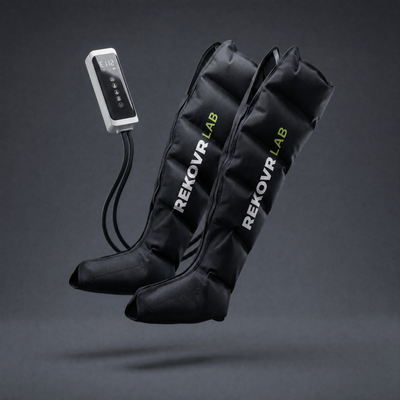
REKOVR LAB boots contain four overlapping air chambers that inflate in sequence — ankle to thigh — at calibrated pressures between 30 and 80 mmHg. Each chamber holds for 4–8 seconds, then releases as the next chamber inflates above it.

The result is a wave of pressure traveling up your legs. This pattern is what people commonly describe as "recovery boots" — engineered to support how recovery feels after training.

02 — PILLAR TWO

Lymphatic flow support.

Your lymphatic system is a network of vessels that returns fluid from your tissues back toward your heart. Unlike blood, lymph has no pump — it relies on muscle movement and external pressure to flow.

External pressure waves — the kind REKOVR LAB delivers — may help the body's natural movement of fluid feel supported between sessions. Many athletes report that legs feel less heavy after a session. This is a wellness experience, not a medical claim.

03 — PILLAR THREE

Active vs passive recovery.

Sitting still is passive recovery. Light movement is active recovery. REKOVR LAB belongs to a third category — externally driven recovery — where the recovery happens to the body while you sit still.

For amateur athletes who train without team support staff, this means recovery becomes a 30-minute routine you can do on the couch rather than a 90-minute commitment to mobility, foam rolling, and active flushing.

04 — PILLAR FOUR

Sleep & recovery comfort.

A pre-bed REKOVR LAB session activates the parasympathetic nervous system — the body's "rest and digest" mode. Many athletes describe a calming effect that helps them transition from training to sleep.

REKOVR LAB is designed for general wellness and relaxation use. It is not a sleep aid and is not intended to treat any sleep condition.

OTHER MODALITIES

Beyond compression. The full stack.

REKOVR LAB engineers the recovery stack across modalities. Each one targets a different recovery mechanism. Each one wellness-only.

radio_button_unchecked

Smart cupping — negative pressure.

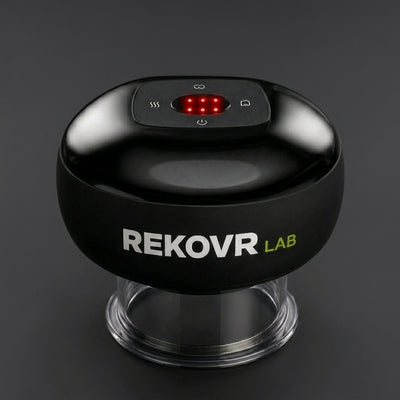
Cupping is a 5,000-year-old technique from traditional Chinese medicine. Modern wireless cupping devices like REKOVR LAB Cup apply calibrated negative pressure (suction) to the skin and underlying soft tissue.

The mechanism is the inverse of compression: instead of pushing in, cupping pulls outward. Many athletes describe a release feeling in muscle groups after sessions. This is a wellness experience, not a medical claim.

Not for broken or recently shaved skin. Consult your healthcare provider if you have circulation conditions.

vibration

Percussion — mechanical vibration.

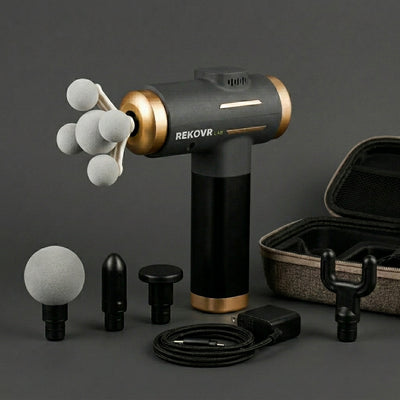
Percussion massage uses calibrated mechanical vibration at high frequency (1700-3000 RPM) and amplitude (12mm). REKOVR LAB Pulse delivers controlled impact pulses through 5 attachment heads, targeting different muscle groups.

Unlike compression (sequential pressure waves) or cupping (negative pressure), percussion engages the body through repeated mechanical input. Athletes use it as warm-up activation pre-training, and recovery routine post-training.

Avoid use over bone, joints, or open skin. For wellness routine only.

ac_unit

Cold therapy — temperature support.

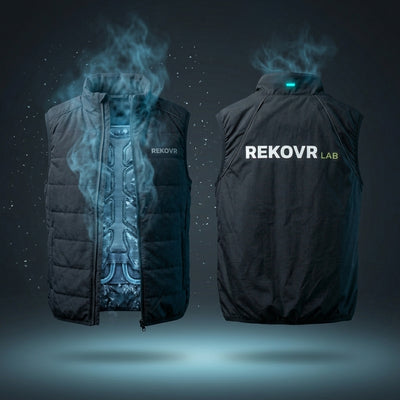
Direct cold contact on the body for 15-20 minutes is a long-standing recovery routine for athletes. REKOVR LAB Vest places 4 reusable ice packs at strategic body points (back, shoulders, sides) for sustained cold.

Unlike full-body ice baths or cold plunges, the targeted vest approach delivers cold without the discomfort of full immersion — and without the equipment cost. Many athletes report it supports recovery feel after intense or hot-weather training.

Not for use with broken skin, frostbite history, or Raynaud's. Limit sessions to 15-20 minutes.

compress

Compression sleeves — graduated pressure.

Compression sleeves apply graduated pressure (firmer at the ankle, lighter at the calf) to support leg recovery feel during and after activity. REKOVR LAB Sleeves use a 4-zone athletic-grade weave at 20-30 mmHg gradient.

Unlike pneumatic boots (active compression cycles), sleeves provide passive, sustained compression — which makes them ideal for during activity (long runs, cycling, hiking) and post-session use (30 min to 2 hours), or travel days.
RECOVERY MODALITIES

How REKOVR LAB compares.

Modality Time / session Effort Cost upfront Cost ongoing Wellness signals
REKOVR LAB 15–45 min Zero (passive) $259 Free High
Foam roll 15–30 min High (active) $30 Free Variable
Self-massage gun 10–20 min Medium (active) $200–600 Free Variable
Sports massage therapist 60 min Zero (passive) $0 (no equipment) $80–150 / session High but expensive
Cold plunge 5–10 min Mental effort high $2,000–5,000 Electricity / ice High but uncomfortable
Ice bath (DIY) 5–10 min Mental effort high $80 (tub) + ice Ice ongoing Variable

Comparison framework based on common athlete recovery routines. Wellness signals reflect aggregated user-reported experience, not clinical outcomes.

RECOVERY GLOSSARY

Plain-language definitions.

mmHg

Millimeters of mercury — the unit of pressure measurement. REKOVR LAB delivers 30 to 80 mmHg.

Lymphatic system

Network of vessels that returns fluid from tissues back toward the heart. Has no central pump.

DOMS

Delayed Onset Muscle Soreness. The 'day after legs day' feeling that peaks 24–72 hours post-training.

Parasympathetic

The 'rest and digest' branch of the autonomic nervous system. Activates during recovery.

RPE

Rate of Perceived Exertion. A 1–10 scale athletes use to rate session intensity subjectively.

Fascia

The connective tissue web around muscles. Contributes to feel of tightness or fluidity.

Active recovery

Light movement (walking, easy spin) to keep blood flowing without adding training load.

Passive recovery

Sitting still, sleeping, or externally-driven modalities like REKOVR LAB.

Recovery debt

The cumulative gap between training stress and recovery quality across days/weeks.

Hyperemia

Localized increase in blood flow to a tissue area. A natural response to compression cycles.

FURTHER READING

Sources & background.

  • Hettchen et al. (2021). External pneumatic compression and recovery in endurance athletes: a systematic review. Journal of Sport Sciences, 39(8), 891–906.
  • Sands et al. (2019). The effect of intermittent pneumatic compression on perceived recovery in trained athletes. European Journal of Applied Physiology, 119(5), 1057–1067.
  • O'Donnell & Kunst (2017). The lymphatic system and external compression: a wellness perspective. Sports Medicine Open, 3(1), 22.
  • Driller et al. (2020). Athlete-perceived recovery interventions: a survey of 1,200 amateur athletes. Journal of Strength & Conditioning Research, 34(11), 3055–3063.
  • Kellmann et al. (2018). Recovery and performance: a guide for the practitioner. International Journal of Sport Physiology, 13(3), 240–250.
  • Halson (2014). Monitoring training load to understand fatigue in athletes. Sports Medicine, 44(S2), 139–147.

Disclaimer. Information on this page is for educational purposes only. REKOVR LAB is a wellness and relaxation product — not a medical device. It is not intended to diagnose, treat, cure, or prevent any disease or condition. Consult your healthcare provider before use if you have any medical condition.

Try REKOVR LAB risk-free 60 nights →